


Valantis Group
Since 2019 (formerly Areon Logistics), Valantis Group has been a logistics company specializing in freight transportation services in Armenia. We provide reliable and efficient air, sea, and road freight solutions.
Since 2022, we have expanded our range of services to include import and export solutions, making international trade simpler and more efficient for our customers.
Trust Valantis Group for fast, reliable, and secure freight transportation.

years of work experience

cargo transportation

partners

types of service


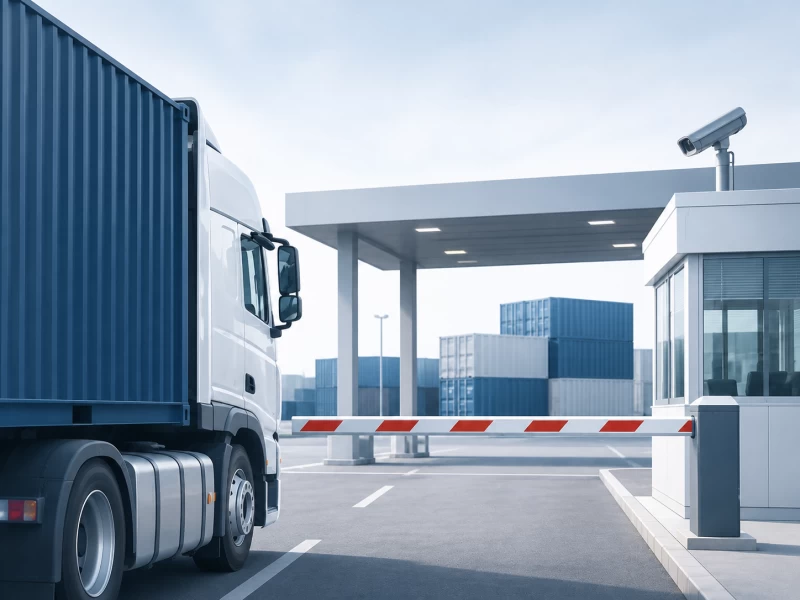
International Freight Restrictions: What You Need to Know
International Freight Restrictions: What You Need to Know
Organizing international freight transportation involves more than simply choosing a suitable mode of transport, calculating shipping costs, and agreeing on delivery schedules.
In recent years, changes in international trade regulations, export controls, and sanctions have significantly complicated the transportation of certain goods. As a result, even when the import or export of a product is legally permitted, the selected transit route may be subject to additional restrictions.
These challenges are particularly relevant to international shipments involving Armenia, where cargo often passes through several countries, each with its own customs regulations and legal requirements.
Customs Classification and Its Importance
In international trade, goods are classified under specific customs codes based on the Harmonized System (HS). In Armenia, the Commodity Nomenclature of Foreign Economic Activity (TN VED) is used within the framework of the Eurasian Economic Union (EAEU).
These codes are used to determine the customs duties, taxes, permits, and potential restrictions applicable to particular goods.
However, it is important to understand that a customs code alone is not always sufficient to determine whether a shipment can proceed.
In certain cases, additional information must also be reviewed, including:
-
The product's technical specifications and intended use.
-
The manufacturer, country of origin, and destination country.
-
The end user and intended end use.
-
Required export or transit permits.
-
The transportation route and restrictions imposed by transit countries.
Consequently, transporting the same product may be permitted along one route while requiring additional checks or being prohibited along another.
Exporting from Armenia: Which Goods May Be Subject to Restrictions?
Exports from Armenia are regulated by national legislation, applicable EAEU regulations, and international obligations.
Particular attention is given to dual-use goods, technologies, and equipment that can be used for both civilian and military purposes.
Depending on their technical specifications, this category may include certain electronic components, measuring instruments, industrial technologies, communication systems, and other products.
Exporting such goods may require a specialized assessment, an official classification conclusion, or an export license.
It is important to note that classifying a product as dual-use does not automatically mean that its export is completely prohibited. In some cases, export is possible once the necessary permits have been obtained and all applicable requirements have been met.
However, if a product is subject to export controls, missing documentation may result in customs clearance delays or the rejection of the export shipment.
Shipping from China to Armenia via Russia: Why Can Transit Become Complicated?
Various overland routes are used to transport goods from China to Armenia, including routes passing through Russia.
However, not all products can be transported along every available route.
Certain goods may be subject to Chinese export control requirements, while additional customs, transit, or carrier-imposed restrictions may apply when transporting cargo through Russian territory.
Particular attention may be required for products containing specialized electronic components, communication or measuring equipment, certain industrial technologies, or other controlled goods.
In such cases, before arranging transportation, it is essential to determine whether the goods can be exported from China, accepted by the selected carrier, and transported through the countries along the planned route.
It is also important to distinguish between legal prohibitions and restrictions imposed by carriers.
For example, some freight carriers may refuse to transport certain goods due to insufficient documentation, additional inspection requirements, or their own risk assessments. However, this does not automatically mean that transporting those goods is prohibited by law.
This distinction is particularly important when considering alternative transportation routes.
European Routes: The Impact of Sanctions on Freight Transportation
Sanctions imposed by the European Union against Russia continue to affect international trade and freight transportation.
These restrictions apply to the export, import, and supply of certain goods and, in some cases, their transit through Russian territory.
Controlled goods may include certain industrial equipment, technological components, electronics, and dual-use products.
When transporting goods from European countries to Armenia, it is important to examine not only the final destination but also the entire transportation route.
EU export control requirements may include checks on the end user, the intended use of the goods, and potential re-export risks.
As a result, certain shipments may require additional documentation, compliance checks, or changes to the transportation route.
Why Can the Same Product Be Subject to Different Requirements in Different Countries?
One of the key characteristics of international freight transportation is that the rules applicable to a product may vary depending on the country from which it is exported, the countries through which it transits, and the country into which it is ultimately imported.
For example, importing certain industrial equipment into Armenia may be permitted, while exporting the same equipment from its country of origin may require a special license.
In another case, a product may be exported without restrictions but face additional requirements in the selected transit country.
It is also possible for a shipment to be legally permitted while a particular carrier refuses to accept the cargo.
For this reason, assessing the feasibility of international transportation requires examining the entire transportation chain rather than focusing solely on the countries of departure and destination.
How Do Restrictions Affect Freight Transportation?
Restrictions can affect not only whether cargo can be transported but also the entire logistics process.
Potential consequences include:
-
Transportation delays: Additional inspections and document reviews may extend delivery times.
-
Additional costs: Expenses may arise from expert assessments, permits, storage, or documentation procedures.
-
Route changes: In some cases, an alternative transit route may be necessary, provided it complies with applicable legislation.
-
Cargo rejection: A carrier may refuse to accept a shipment due to legal restrictions or unresolved compliance issues.
-
Customs clearance complications: Requests for additional documentation or clarification may affect customs procedures.
Therefore, planning shipments in advance is essential not only for managing costs and delivery schedules but also for ensuring regulatory compliance.
Why Is It Important to Check Restrictions Before Shipping?
Discovering transportation restrictions only after cargo is ready for dispatch can result in wasted time and additional expenses.
This is particularly relevant when shipments contain technological equipment, specialized components, or controlled goods. In such cases, it is advisable to review their customs classification and applicable requirements in advance.
Where necessary, the relevant assessments or permits should be obtained from the competent authorities before transportation begins.
It is important to remember that permission to import a product does not necessarily mean it can be transported along any international route.
Conclusion
International freight restrictions have become an important factor in logistics planning.
Export control requirements, international sanctions, and transit regulations can directly affect the feasibility, cost, and delivery time of a shipment.
Therefore, before arranging international freight transportation, it is essential to assess not only the cargo's weight, volume, and destination but also its customs classification, technical specifications, and the restrictions applicable throughout the planned route.
Valantis Group recognizes the importance of reviewing cargo characteristics and transportation routes in advance, helping customers evaluate available logistics solutions and identify potential transportation risks at an early stage.
13.11.2026
How Much Cargo Can Fit in a Truck or Container?
When planning a shipment, one of the most common questions customers ask is: How much cargo can fit in a truck or container?
At first glance, the answer may seem simple. However, the actual capacity of a truck or container depends not only on the weight of the cargo or the available loading space.
The correct choice of equipment and the possibility of loading the cargo depend on several important factors, including weight, volume, dimensions, packaging, cargo characteristics, route, and applicable weight restrictions.
Therefore, when planning transportation, knowing only the total weight of the cargo is often not enough.
Truck Capacity
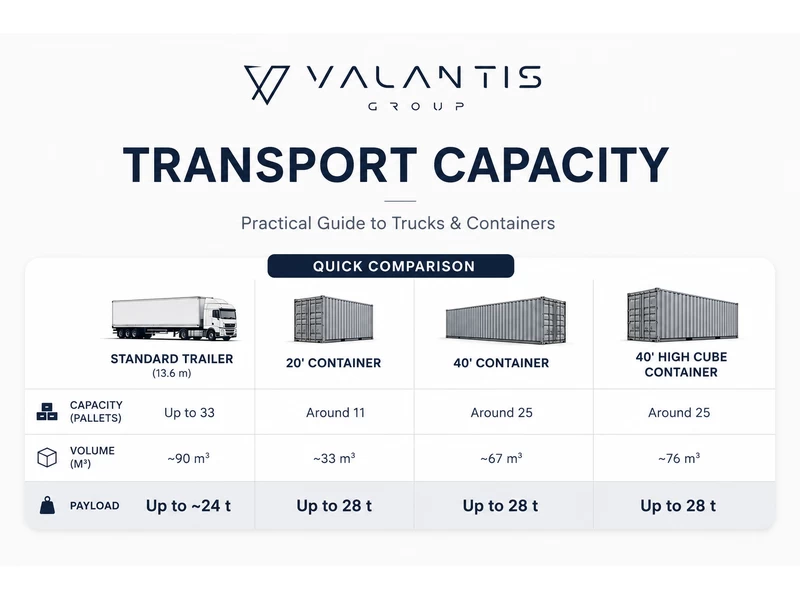
A standard curtain-side trailer usually offers approximately 80–90 m³ of loading space, although the exact capacity depends on the type and configuration of the trailer.
At the same time, using the entire available loading space does not mean that the truck can carry the maximum possible weight.
On many international routes, the practical payload of a standard trailer is around 22–24 tons. However, the permitted maximum weight may vary depending on the vehicle's technical specifications, road regulations, route, and other restrictions.
For this reason, both volume and weight need to be considered when evaluating a shipment.
For example:
- 5 tons of compact machinery may occupy relatively little space;
- the same 5 tons of large but lightweight products may occupy a significant part of the trailer.
In other words, a heavier shipment does not necessarily require more loading space.
Container Capacity
In sea freight, the most commonly used standard containers include 20-foot, 40-foot, and 40-foot High Cube containers.
20-foot container
A standard 20-foot container has an internal volume of approximately 33 m³.
Its maximum payload depends on the tare weight of the specific container, the type of container, and the transportation conditions. In many cases, it can reach approximately 25–28 tons, but the actual permitted weight should always be checked for the specific container and route.
40-foot container
A standard 40-foot container has an internal volume of approximately 67 m³.
It is generally used for cargo that requires more loading space.
It is important to note that a 40-foot container does not necessarily allow twice as much weight to be transported as a 20-foot container. In many cases, the limiting factor is not volume but the maximum permitted gross weight.
40-foot High Cube
A 40-foot High Cube container has an internal volume of approximately 76 m³.
Its additional internal height makes it particularly suitable for bulky but relatively lightweight cargo.
| Equipment | Approx. Internal Volume | Payload |
|---|---|---|
| 20' Container | ~33 m³ | Depends on container and route |
| 40' Container | ~67 m³ | Depends on container and route |
| 40' High Cube | ~76 m³ | Depends on container and route |
| Standard Trailer | ~80–90 m³ | Often around 22–24 tons |
Note: The figures above are approximate. The actual permitted payload depends on the specific equipment, cargo, route, and applicable weight restrictions.
Why Isn't Weight Alone Enough?
When planning transportation, it is important to understand the difference between volume capacity and weight capacity.
Imagine two different shipments, both weighing 10 tons.
The first may consist of dense and compact machinery and occupy only part of the available loading space.
The second may consist of large but relatively lightweight products. In this case, the same 10 tons may occupy almost the entire available loading space.
That is why selecting the right equipment requires not only the total weight, but also the total volume and dimensions of the cargo.
What Information Is Needed to Calculate the Shipment Correctly?
To select the appropriate transportation solution and calculate the cost accurately, it is recommended to provide the following information:
- Cargo description
- Number of packages or pallets
- Dimensions of each package: length × width × height
- Weight of each package
- Total gross weight
- Total volume
- Pallet dimensions
- Whether the cargo can be stacked
- Any special loading or unloading requirements
- Pickup and delivery locations
Based on this information, it is possible to determine more accurately what type of equipment is required and how the available loading space can be used most efficiently.
Truck or Container?
The choice between a truck and a container should not be based only on their volume.
For example, a 40-foot High Cube container has approximately 76 m³ of internal volume, while a standard trailer can offer around 80–90 m³.
However, this does not mean that both options are equally suitable for every shipment.
The choice may depend on:
- Pickup and delivery locations
- Route
- Transit time
- Cargo weight and volume
- Cargo dimensions
- Port availability
- Customs procedures
- Loading and unloading requirements
- Transportation cost
For example, for large-volume shipments from China to Armenia, sea or rail container transportation may be an efficient solution. For transportation between Armenia, Georgia, Russia, Europe, and other destinations, road transportation can often provide greater flexibility and door-to-door delivery.
Heavy and Oversized Cargo
Special attention is required for heavy, long, wide, or high cargo.
Even if the cargo technically fits inside a truck or container, its transportation may still be restricted by other factors.
For example, it is necessary to consider:
- Internal dimensions of the truck or container
- Door opening dimensions
- Total cargo weight
- Weight distribution across the axles
- Permitted floor load
- Loading equipment requirements
- Road and local weight restrictions
For particularly heavy or oversized cargo, it is important to assess the feasibility of transportation before final packing and booking the equipment.
Accurate Information Helps Avoid Additional Costs
Incorrect cargo dimensions or weight can lead to additional problems during transportation.
If the actual dimensions are larger than originally declared, it may be necessary to change the equipment, rearrange the cargo, or pay additional charges.
That is why providing accurate cargo information is essential when calculating transportation costs.
Accurate information → the right equipment → a more accurate quotation → fewer unexpected costs.
How to Choose the Right Transportation Solution
There is no single transportation option that is suitable for every shipment.
A shipment of 5 tons and 5 m³ may require a completely different solution from a shipment of 25 tons and 60 m³.
The same applies to palletized goods, machinery, vehicles, and oversized cargo.
The most efficient solution is determined by considering cargo weight, volume, dimensions, route, delivery timeframe, and transportation requirements.
At Valantis Group, we help customers evaluate these factors and select the most suitable transportation solution for their cargo.
19.08.2026
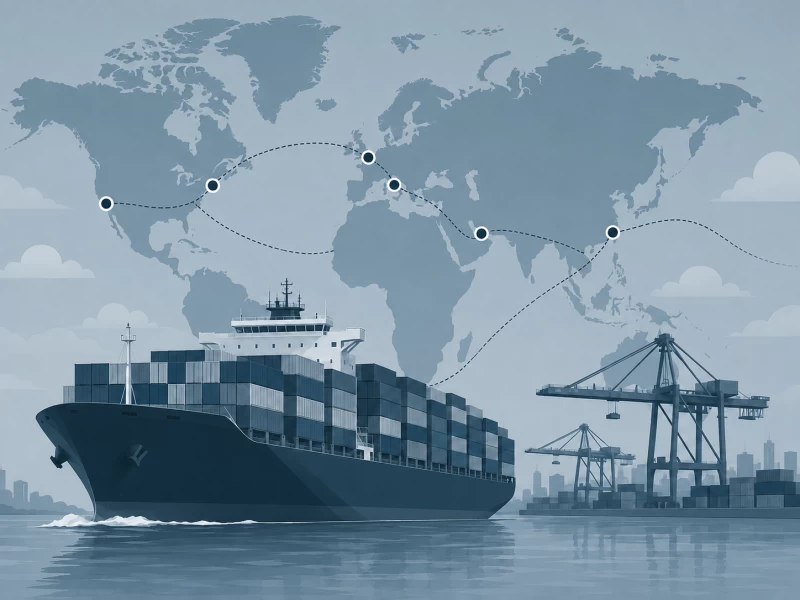
Why Are Sea Freight Transit Times Increasing? Market Update – August 2026
Over the past few months, many importers have noticed that sea freight transit times have become less predictable. Containers that previously arrived on schedule are now taking longer to reach their destination. This is not caused by a single issue, but by several global factors that continue to affect international shipping.
Here's what's happening in the market.
The Red Sea Situation Continues to Affect Shipping
The Suez Canal has long been the shortest and most efficient route between Asia and Europe. However, due to ongoing security concerns in the Red Sea, many shipping lines continue to avoid this route and sail around the Cape of Good Hope in South Africa instead.
Although this allows vessels to operate more safely, it also adds considerable distance to each voyage. Longer routes increase transit times, fuel consumption, and operating costs, affecting shipping schedules worldwide.
Alternative Routes Are Under Pressure
As carriers adjust their networks, more cargo is being redirected through alternative logistics corridors, including the Black Sea.
For shipments moving from China to Armenia, this means greater reliance on routes through Georgia, increasing cargo volumes across the region.
What Is Happening at Poti Port
As one of the main gateways to the Caucasus, Poti Port is handling increased cargo volumes. While operations continue as normal, higher demand can lead to longer container handling times, customs processing, and truck loading, which may affect delivery schedules to Armenia.
Peak Season Is Adding More Demand
August marks the beginning of the annual peak shipping season. Manufacturers increase exports ahead of autumn sales and the holiday period, reducing available vessel space and making schedule changes more common.
During this period, booking shipments early becomes more important than ever.
What Does This Mean for Importers?
While international shipping continues to operate, businesses should be prepared for more flexible transit times and occasional schedule changes. Planning shipments in advance, allowing extra time for delivery, and working with a reliable logistics partner can help reduce the impact of current market conditions.
Global logistics continues to evolve, and today's shipping environment requires more planning and flexibility than ever before. Understanding market changes allows businesses to make informed decisions and keep their supply chains moving efficiently.
At Valantis Group, we closely monitor market developments and work with our partners to provide the most reliable transportation solutions for our customers.
06.08.2026

New Service: Rail Freight Transportation from China to Armenia
We are pleased to announce that Valantis Group continues to expand its logistics solutions by introducing a new service: rail freight transportation from China to Armenia via Georgia.
In today's global supply chain environment, businesses require transportation solutions that are reliable, cost-effective, and efficient. Rail freight has become one of the fastest-growing modes of international transportation, offering an excellent balance between transit time, cost, and reliability.
Why Choose Rail Freight Transportation?
Rail freight provides businesses with a practical alternative to traditional transportation methods, combining operational efficiency with competitive pricing.
Cost-Effective Solution
Rail transportation is often more economical than Full Truck Load (FTL) road transport, particularly for medium and large-volume shipments. This allows companies to optimize logistics costs while maintaining high service standards.
Optimized Transit Times
Rail freight offers stable and predictable transit schedules and, on certain routes, can provide faster delivery compared to road transportation. This helps businesses improve supply chain planning and inventory management.
Reliable and Consistent Operations
Unlike road transport, rail networks operate on fixed schedules, reducing the impact of traffic congestion, road restrictions, and other external factors. As a result, shipments benefit from greater predictability and reliability.
Suitable for Various Cargo Types
The service is ideal for a wide range of cargo, including consumer goods, industrial equipment, raw materials, and other commercial shipments, ensuring safe and efficient transportation from China to Armenia.
New Logistics Opportunities for Armenian Businesses
China remains one of the key sourcing markets for Armenian importers, and companies are constantly seeking transportation solutions that balance cost, speed, and reliability. Rail freight transportation offers exactly that—an efficient alternative that helps optimize logistics expenses while maintaining dependable transit times.
By expanding our service portfolio, Valantis Group continues to provide modern and flexible logistics solutions tailored to the evolving needs of businesses engaged in international trade.
10.06.2026