19.08.2026
When planning a shipment, one of the most common questions customers ask is: How much cargo can fit in a truck or container?
At first glance, the answer may seem simple. However, the actual capacity of a truck or container depends not only on the weight of the cargo or the available loading space.
The correct choice of equipment and the possibility of loading the cargo depend on several important factors, including weight, volume, dimensions, packaging, cargo characteristics, route, and applicable weight restrictions.
Therefore, when planning transportation, knowing only the total weight of the cargo is often not enough.
Truck Capacity
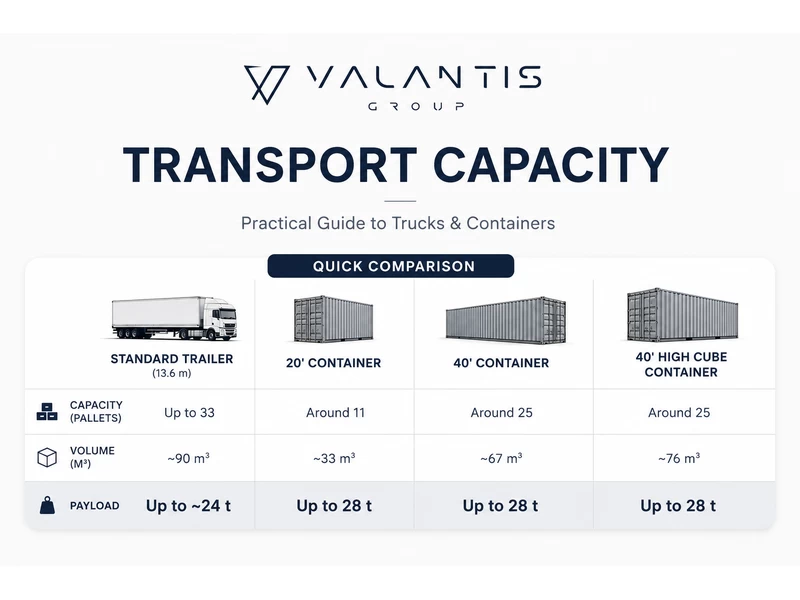
A standard curtain-side trailer usually offers approximately 80–90 m³ of loading space, although the exact capacity depends on the type and configuration of the trailer.
At the same time, using the entire available loading space does not mean that the truck can carry the maximum possible weight.
On many international routes, the practical payload of a standard trailer is around 22–24 tons. However, the permitted maximum weight may vary depending on the vehicle's technical specifications, road regulations, route, and other restrictions.
For this reason, both volume and weight need to be considered when evaluating a shipment.
For example:
- 5 tons of compact machinery may occupy relatively little space;
- the same 5 tons of large but lightweight products may occupy a significant part of the trailer.
In other words, a heavier shipment does not necessarily require more loading space.
Container Capacity
In sea freight, the most commonly used standard containers include 20-foot, 40-foot, and 40-foot High Cube containers.
20-foot container
A standard 20-foot container has an internal volume of approximately 33 m³.
Its maximum payload depends on the tare weight of the specific container, the type of container, and the transportation conditions. In many cases, it can reach approximately 25–28 tons, but the actual permitted weight should always be checked for the specific container and route.
40-foot container
A standard 40-foot container has an internal volume of approximately 67 m³.
It is generally used for cargo that requires more loading space.
It is important to note that a 40-foot container does not necessarily allow twice as much weight to be transported as a 20-foot container. In many cases, the limiting factor is not volume but the maximum permitted gross weight.
40-foot High Cube
A 40-foot High Cube container has an internal volume of approximately 76 m³.
Its additional internal height makes it particularly suitable for bulky but relatively lightweight cargo.
| Equipment | Approx. Internal Volume | Payload |
|---|---|---|
| 20' Container | ~33 m³ | Depends on container and route |
| 40' Container | ~67 m³ | Depends on container and route |
| 40' High Cube | ~76 m³ | Depends on container and route |
| Standard Trailer | ~80–90 m³ | Often around 22–24 tons |
Note: The figures above are approximate. The actual permitted payload depends on the specific equipment, cargo, route, and applicable weight restrictions.
Why Isn't Weight Alone Enough?
When planning transportation, it is important to understand the difference between volume capacity and weight capacity.
Imagine two different shipments, both weighing 10 tons.
The first may consist of dense and compact machinery and occupy only part of the available loading space.
The second may consist of large but relatively lightweight products. In this case, the same 10 tons may occupy almost the entire available loading space.
That is why selecting the right equipment requires not only the total weight, but also the total volume and dimensions of the cargo.
What Information Is Needed to Calculate the Shipment Correctly?
To select the appropriate transportation solution and calculate the cost accurately, it is recommended to provide the following information:
- Cargo description
- Number of packages or pallets
- Dimensions of each package: length × width × height
- Weight of each package
- Total gross weight
- Total volume
- Pallet dimensions
- Whether the cargo can be stacked
- Any special loading or unloading requirements
- Pickup and delivery locations
Based on this information, it is possible to determine more accurately what type of equipment is required and how the available loading space can be used most efficiently.
Truck or Container?
The choice between a truck and a container should not be based only on their volume.
For example, a 40-foot High Cube container has approximately 76 m³ of internal volume, while a standard trailer can offer around 80–90 m³.
However, this does not mean that both options are equally suitable for every shipment.
The choice may depend on:
- Pickup and delivery locations
- Route
- Transit time
- Cargo weight and volume
- Cargo dimensions
- Port availability
- Customs procedures
- Loading and unloading requirements
- Transportation cost
For example, for large-volume shipments from China to Armenia, sea or rail container transportation may be an efficient solution. For transportation between Armenia, Georgia, Russia, Europe, and other destinations, road transportation can often provide greater flexibility and door-to-door delivery.
Heavy and Oversized Cargo
Special attention is required for heavy, long, wide, or high cargo.
Even if the cargo technically fits inside a truck or container, its transportation may still be restricted by other factors.
For example, it is necessary to consider:
- Internal dimensions of the truck or container
- Door opening dimensions
- Total cargo weight
- Weight distribution across the axles
- Permitted floor load
- Loading equipment requirements
- Road and local weight restrictions
For particularly heavy or oversized cargo, it is important to assess the feasibility of transportation before final packing and booking the equipment.
Accurate Information Helps Avoid Additional Costs
Incorrect cargo dimensions or weight can lead to additional problems during transportation.
If the actual dimensions are larger than originally declared, it may be necessary to change the equipment, rearrange the cargo, or pay additional charges.
That is why providing accurate cargo information is essential when calculating transportation costs.
Accurate information → the right equipment → a more accurate quotation → fewer unexpected costs.
How to Choose the Right Transportation Solution
There is no single transportation option that is suitable for every shipment.
A shipment of 5 tons and 5 m³ may require a completely different solution from a shipment of 25 tons and 60 m³.
The same applies to palletized goods, machinery, vehicles, and oversized cargo.
The most efficient solution is determined by considering cargo weight, volume, dimensions, route, delivery timeframe, and transportation requirements.
At Valantis Group, we help customers evaluate these factors and select the most suitable transportation solution for their cargo.